What the human research shows
A genuinely interesting laboratory result that has not moved toward people in nine years. Grade D is a statement of what exists, not a verdict on the mechanism.
Evidence profile0–5
- Metabolic & weight—0.0
- Cardiovascular—0.0
- Muscle & growth—0.0
- Healing & repair—0.0
- Neuro & sleep—0.0
- Immune & inflammation—0.0
- Sexual & hormonal—0.0
- Skin & appearance—0.0
- Ageing & longevity—0.0
| Outcome | Grade | Effect size | Human studies | Where the evidence comes from |
|---|---|---|---|---|
| Any outcome in humans | DNo human evidence | Not measurable | 0 | No clinical study is registered or published. LYO's search found none.2 |
| Fitness, fur density and renal function (aged mice) | DNo human evidence | Large | Animal only | Baar and colleagues report selective clearance of senescent cells and functional restoration in fast-ageing and naturally aged mice, and protection against chemotherapy toxicity.1 |
| Senescent cell clearance (human cells in vitro) | DNo human evidence | Moderate | Cell culture | Removed senescent cells from expanded human chondrocytes in a 2021 study — the closest the compound has come to a human tissue.3 |
Literature searched to 23 September 2026. Human studies only; animal and cell work informs the mechanism section and nothing else.
What it is
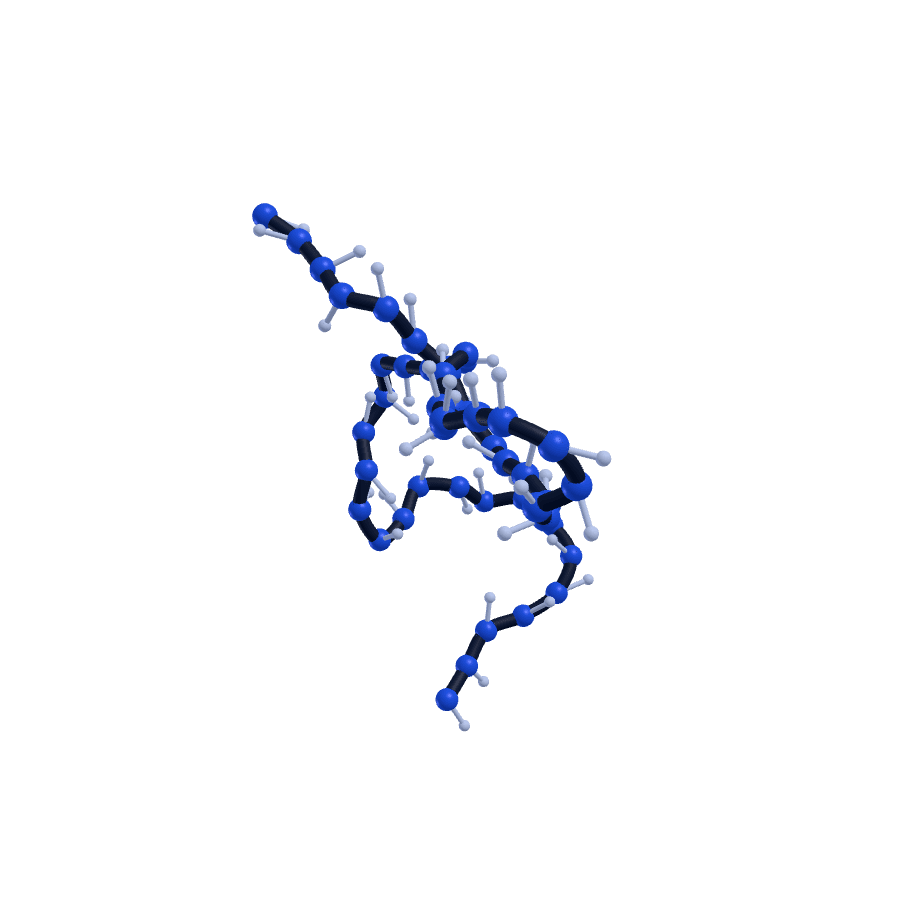
FOXO4-DRI is a 46-residue peptide built from D-amino acids in reverse order ('retro-inverso'), which makes it resistant to breakdown while keeping the shape of the FOXO4 region that binds p53. It was designed at the Erasmus Medical Center in Rotterdam by Peter de Keizer's group and published in Cell in 2017.
A start-up (Cleara Biotech) pursued a derivative, Proxofim, for cancer and ageing; no human trial has been announced. Meanwhile the original sequence is synthesised and sold online as a 'senolytic peptide'.
How it is thought to work
Senescent cells survive partly because FOXO4 holds p53 in the nucleus and away from the apoptosis programme. The peptide competes for that interaction, releases p53, and the senescent cell — but not its healthy neighbours — dies. The selectivity in mice was striking; whether it holds in people, and at what cost, is untested.
What is still unknown
- Safety in humans: p53 is a tumour suppressor, and manipulating it is not trivial.
- Dose, route and pharmacokinetics in any human — none reported.
- Whether a 46-residue D-peptide is even what the vials contain; no product testing is public.
The molecule and how long it lasts
- Formula
- C228H388N86O64
- Molecular weight
- 5358 g/mol
- CAS number
- 2460055-10-9
- PubChem
- CID 167312269
Record is the TFA salt form
PubChem record, read 23 September 2026.
- Route
- Injected as sold; no human study
- Half-life
- No human pharmacokinetic data
No pharmacokinetic study in people.
Regulatory status
Preclinical; supply for human use is unlawful.
Not FDA-approved; no IND announced.
Unlicensed.
Not registered.
No Drug Identification Number.
Unapproved, so S0 (non-approved substances).
Questions people actually ask
Has FOXO4-DRI been tested in humans?
Is FOXO4-DRI a senolytic?
Why is it sold if untested?
One page per claimed effect
- DDoes FOXO4-DRI help with any outcome in humans?0
- DDoes FOXO4-DRI help with fitness, fur density and renal function?Animal only
- DDoes FOXO4-DRI help with senescent cell clearance?Cell culture
References
- 1
- 2PubMed and ClinicalTrials.gov search: FOXO4-DRI — no human study identified.Searched 2026-09-23
- 3Senolytic peptide FOXO4-DRI selectively removes senescent cells from in vitro expanded human chondrocytes.Front Bioeng Biotechnol, 2021Human cells in culture.
Change log
- 2026-09-23Initial publication. Grade D: no human study.