What the human research shows
Real, reproducible endocrinology — a genuine GH spike — that runs into the wall every GH secretagogue hits: the body adapts, the marker stops moving, and no trial ever showed it changes anything you can see or feel. Banned in sport.
Evidence profile0–5
- Metabolic & weight—0.0
- CardiovascularD0.0
- Muscle & growthC1.3
- Healing & repair—0.0
- Neuro & sleep—0.0
- Immune & inflammation—0.0
- Sexual & hormonal—0.0
- Skin & appearance—0.0
- Ageing & longevity—0.0
| Outcome | Grade | Effect size | Human studies | Where the evidence comes from |
|---|---|---|---|---|
| Growth hormone release | CWeak | Moderate | Multiple acute studies + 1 chronic study | Acute GH release after hexarelin is large and well established. Over 16 weeks of twice-daily dosing the response attenuated and then recovered after stopping — a tolerance effect typical of the class.1 |
| Body composition | DNo human evidence | Not measurable | 1 chronic study (n small) | In the only sustained-dosing study, IGF-1, body fat, lean mass and bone density did not change significantly over 16 weeks.1 |
| Cardiac effects | DNo human evidence | Not measurable | Mechanistic only | Hexarelin binds a receptor (CD36) in the heart and has cardiovascular effects in animals and acute human physiology studies. No controlled trial has tested a clinical cardiac outcome.2 |
| Safety in humansadverse | CWeak | Small | Early-phase | Short-term dosing is generally well tolerated in the small studies; transient flushing and mild cortisol/prolactin rises are described. No long-term safety data.1 |
Literature searched to 3 September 2026. Human studies only; animal and cell work informs the mechanism section and nothing else.
What it is
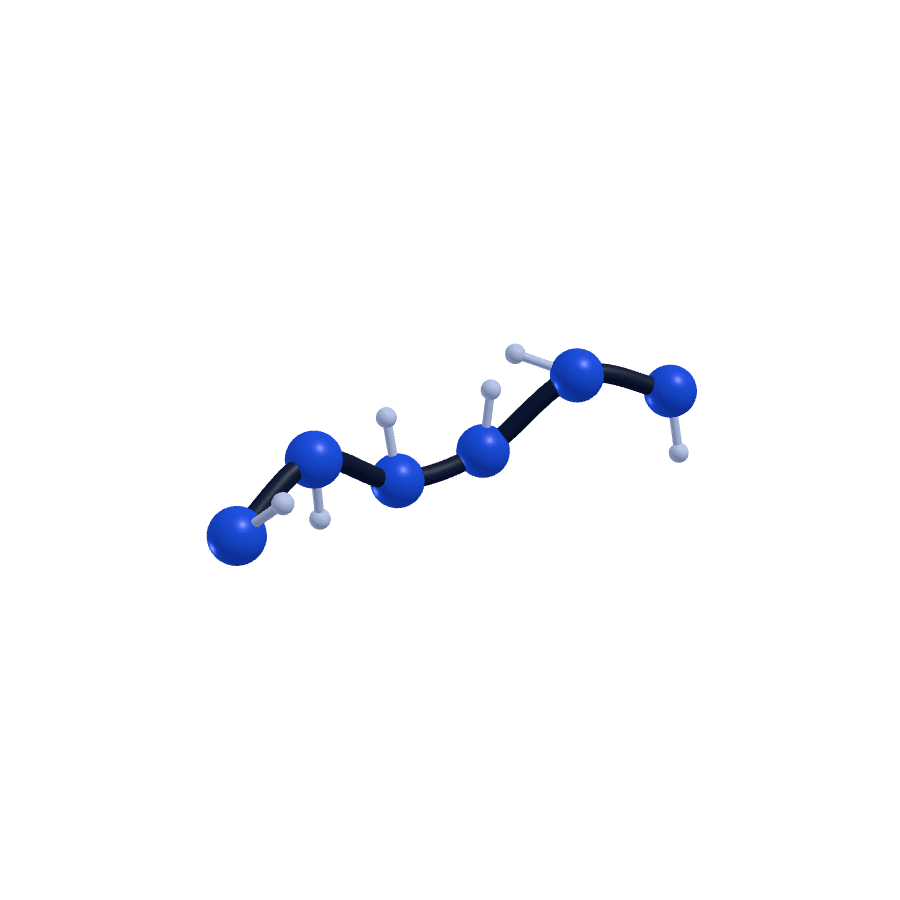
Hexarelin is one of the original growth-hormone-releasing peptides (GHRPs), a hexapeptide that stimulates growth-hormone secretion by acting on the ghrelin/GH-secretagogue receptor. It was studied in the 1990s as a possible GH-deficiency treatment and diagnostic.
It is sold on the grey market for muscle, recovery and 'anti-ageing', none of which it was ever shown to do in a trial.
How it is thought to work
It activates the GH-secretagogue receptor in the hypothalamus and pituitary, driving pulses of growth-hormone release. Continued exposure desensitises that response — the reason a molecule that clearly 'works' acutely never produced a durable clinical effect.
What is still unknown
- Whether any dosing schedule produces a change in body composition or function that a person would notice — untested.
- Long-term safety, including the effects of chronic receptor stimulation.
- Whether the animal cardiac findings mean anything in people.
The molecule and how long it lasts
- Formula
- C47H58N12O6
- Molecular weight
- 887.0 g/mol
- CAS number
- 140703-51-1
- PubChem
- CID 6918297
PubChem record, read 23 September 2026.
- Route
- Intravenous in human GH-response studies, which report no PK
- Half-life
- No human pharmacokinetic data. Dog intravenous terminal half-life about 2 hours
Animal data only — no human pharmacokinetic study: Roumi M, et al. Radioimmunoassay for hexarelin and its pharmacokinetic studies. Peptides 1995;16
Regulatory status
No marketing authorisation in any member state. Supplying it for human use is an offence under national medicines law; a 'research use only' label does not change that.
Not an approved drug and not a dietary-supplement ingredient. Sold as a 'research chemical' outside the medical system; the FDA has warned against several compounds in this class.
Not licensed by the MHRA. Selling or supplying it for human use is an offence under the Human Medicines Regulations 2012.
Not on the ARTG. Supply without a prescription is unlawful; imports are seized.
No Drug Identification Number; selling it for human use is illegal.
WADA class S2.2: growth-hormone secretagogues and GH-releasing peptides are banned in and out of competition.
Questions people actually ask
Does hexarelin build muscle?
Why does it 'stop working'?
Is it allowed in sport?
One page per claimed effect
- CDoes Hexarelin help with growth hormone release?Multiple acute studies + 1 chronic study
- DDoes Hexarelin help with body composition?1 chronic study (n small)
- DDoes Hexarelin help with cardiac effects?Mechanistic only
- CHow common is safety in humans with Hexarelin?Early-phase
References
- 1Rahim A, et al. Growth hormone status during long-term hexarelin therapy.J Clin Endocrinol Metab, 1998;83:1644–164916 weeks; GH response attenuates, IGF-1 and body composition unchanged.
- 2Arvat E, et al. Endocrine activities of ghrelin in humans: comparison with hexarelin and GHRH.J Clin Endocrinol Metab, 2001;86:1169–1174Acute GH-releasing potency of hexarelin in people.
Change log
- 2026-09-03Initial publication. Grade C on a real but self-limiting GH effect and no outcome data.