What the human research shows
One of the clearest cases on this site of a laboratory tool being sold as a physique drug. The parent hormone is well characterised and even approved for a narrow indication; the analogue people actually inject has never been given to a human in a trial.
Evidence profile0–5
- Metabolic & weight—0.0
- Cardiovascular—0.0
- Muscle & growth—0.0
- Healing & repair—0.0
- Neuro & sleep—0.0
- Immune & inflammation—0.0
- Sexual & hormonal—0.0
- Skin & appearance—0.0
- Ageing & longevity—0.0
| Outcome | Grade | Effect size | Human studies | Where the evidence comes from |
|---|---|---|---|---|
| Muscle growth | DNo human evidence | Not measurable | 0 controlled | No controlled human trial of IGF-1 LR3 exists for muscle, strength or body composition. The claims extrapolate from IGF-1's known role in tissue growth and from animal and cell work. |
| Any clinical outcome | DNo human evidence | Not measurable | 0 controlled | A PubMed search for the compound and its aliases returns recombinant-expression papers, rodent studies and reviews of self-administration — no human trial. |
| Safety in humansadverse | DNo human evidence | Not measurable | None | No human dosing study exists. The theoretical concerns are hypoglycaemia, because IGF-1 has insulin-like activity, and the long-term effect of sustained growth signalling — neither measured in people for this analogue.1 |
Literature searched to 3 September 2026. Human studies only; animal and cell work informs the mechanism section and nothing else.
What it is
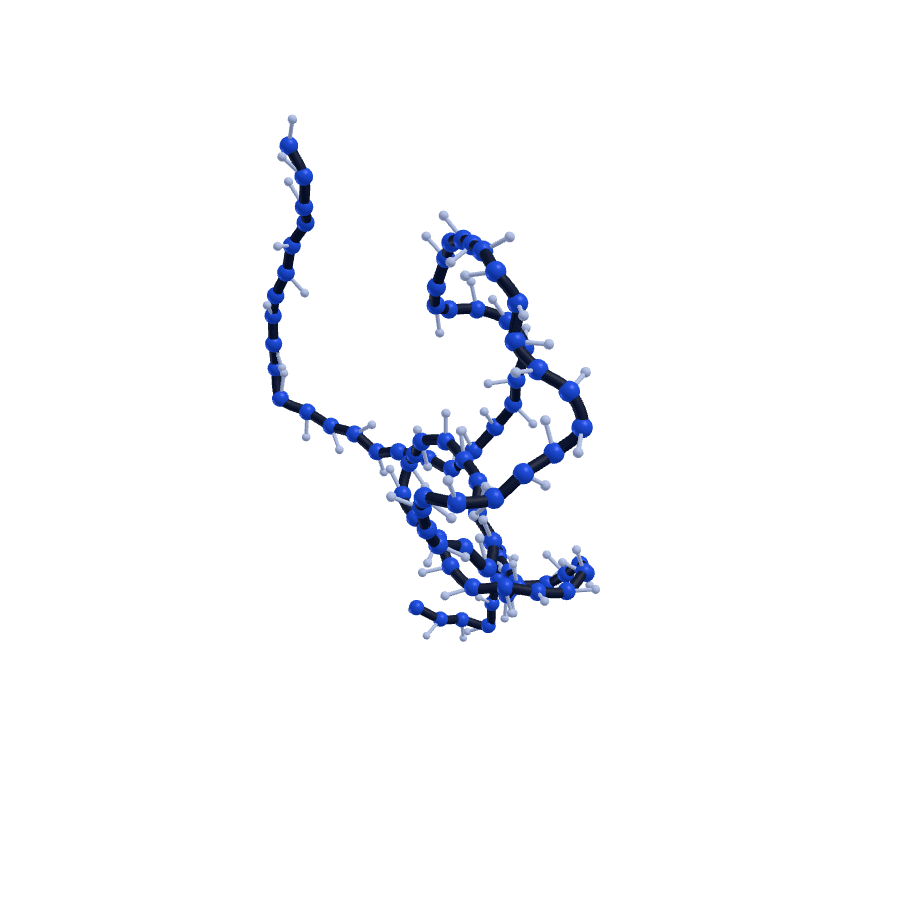
IGF-1 is the hormone through which growth hormone does most of its work. In the body it is almost entirely bound to carrier proteins that regulate how much is active at any moment. LR3 is an analogue with an extra 13-amino-acid extension and a substitution that together stop it binding those carriers.
That modification is useful in a culture flask, where a long-lasting growth signal is convenient. It is exactly what makes the molecule uncontrolled in a person, and it is why the compound was never developed as a medicine.
How it is thought to work
It activates the IGF-1 receptor, and unlike natural IGF-1 it is not restrained by binding proteins. It also has meaningful affinity for the insulin receptor, which is the basis of the hypoglycaemia concern. None of this has been characterised in humans for this analogue.
What is still unknown
- Whether it does anything to muscle in a person.
- Dose, half-life and safety in humans — none established.
- The long-term consequences of unregulated IGF-1 receptor signalling.
The molecule and how long it lasts
An 83-residue protein analogue; not in PubChem Compound at review
- Route
- Injected as sold; no human study (mecasermin is a different, approved product)
- Half-life
- No human pharmacokinetic data
No pharmacokinetic study in people.
Regulatory status
No marketing authorisation. Sold as a research reagent; supplying it for human use is an offence under national medicines law.
Not an approved drug. Mecasermin (recombinant human IGF-1) is approved for severe primary IGF-1 deficiency; the LR3 analogue is a different, unapproved molecule.
No MHRA licence; supply for human use is an offence.
Not on the ARTG; imports are seized.
No Drug Identification Number.
IGF-1 and its analogues are prohibited in and out of competition as growth factors.
Questions people actually ask
Does IGF-1 LR3 build muscle?
Is it the same as the approved IGF-1 drug?
Why is it sold as 'research use only'?
One page per claimed effect
- DDoes IGF-1 LR3 help with muscle growth?0 controlled
- DDoes IGF-1 LR3 help with any clinical outcome?0 controlled
- DHow common is safety in humans with IGF-1 LR3?None
References
- 1Dominikowski A, et al. The emerging landscape of performance-enhancing peptides modulating the GH-IGF1 axis: bridging the gap between clinical evidence and patient self-administration.Front Endocrinol, 2026Review of the gap between evidence and self-administration in this class.
- 2Mecasermin (Increlex) prescribing information — recombinant human IGF-1 for severe primary IGF-1 deficiency.FDA product informationThe approved IGF-1 product, for contrast.
Change log
- 2026-09-03Initial publication. All outcomes graded D on the absence of any human trial of the LR3 analogue.