What the human research shows
The pharmacology is not in question — sermorelin does what it says to the hormone axis, and had a regulatory approval on that basis. What is missing is any well-controlled adult trial showing that the hormone change translates into the outcomes people take it for.
Evidence profile0–5
- Metabolic & weight—0.0
- Cardiovascular—0.0
- Muscle & growthA3.3
- Healing & repair—0.0
- Neuro & sleepD0.0
- Immune & inflammation—0.0
- Sexual & hormonal—0.0
- Skin & appearance—0.0
- Ageing & longevity—0.0
| Outcome | Grade | Effect size | Human studies | Where the evidence comes from |
|---|---|---|---|---|
| Growth hormone / IGF-1 elevation | AEstablished | Moderate | Approval-grade paediatric data | The basis of the 1990 approval as a diagnostic agent: a reliable, measurable GH response. Open-label adult series report IGF-1 rises over 3–6 months.1 |
| Body composition in adults | CWeak | Small | Small studies, mostly open-label | A few small trials and open-label series report modest changes; no adequately powered randomised trial in healthy adults.1 |
| Sleep quality | DNo human evidence | Not measurable | Anecdotal / small | Frequently claimed; the supporting human data is minimal and uncontrolled. |
| Safety in adultsadverse | CWeak | Not measurable | Compounding-era use | Long clinical familiarity from the paediatric era and compounded adult use; no modern controlled long-term dataset. |
Literature searched to 2 September 2026. Human studies only; animal and cell work informs the mechanism section and nothing else.
Registered trials
ClinicalTrials.gov lists 11 interventional studies naming Sermorelin as an intervention — 8 completed, and 4 with results posted to the registry.
A registration is not a result. Anyone can register a study, and many never report — so this list shows what has been attempted, not what has been shown. The graded evidence above is the answer to whether something works.
| Study | Phase | Status | Participants | Sponsor | Results |
|---|---|---|---|---|---|
| Adult Growth Hormone Deficiency and Cardiovascular RiskNCT00720902 · started Feb 2007 | Phase 4 | Terminated | 7 | Columbia University | Posted |
| Effectiveness of Growth Hormone Releasing Hormone in Reducing Abdominal Fat in People Who Are ObeseNCT00675506 · started Jul 2008 | Phase 2 | Completed | 60 | Massachusetts General Hospital | Posted |
| Three Month Treatment of Growth Hormone Releasing Hormone (GHRH) in the ElderlyNCT01410799 · started May 2011 | Phase 2 | Terminated | 13 | University of Pennsylvania | Posted |
| Six Month Treatment of Growth Hormone Releasing Hormone (GHRH) in the ElderlyNCT00807365 · started Dec 2007 | Phase 2 | Terminated | 5 | Johns Hopkins University | Posted |
| Comparative Validation of the Growth Hormone Releasing Hormone and Arginine Test for the Diagnosis of Adult Growth Hormone DeficiencyNCT01060488 · started Jan 2004 | Phase 3 | Completed | 69 | Merck KGaA, Darmstadt, Germany | None |
| SMART: Somatotrophics, Memory, and Aging Research TrialNCT00257712 · started Feb 2006 | Phase 2 | Completed | 151 | University of Washington | None |
| Estradiol-Receptor Blockade in Older Men and WomenNCT02271282 · started Dec 2014 | Phase 1 | Completed | 40 | Mayo Clinic | None |
| The Effect of Growth Hormone Releasing Hormone on Cognitive Function in Individuals With Mild Cognitive ImpairmentNCT02553603 · started Jul 2017 | Phase 1 | Completed | 22 | The University of Texas Medical Branch, Galveston | None |
3 further studies are registered. Participant counts marked * are the sponsor's estimate, not a final enrolment. Source: ClinicalTrials.gov, read directly from the registry and refreshed weekly.
What it is
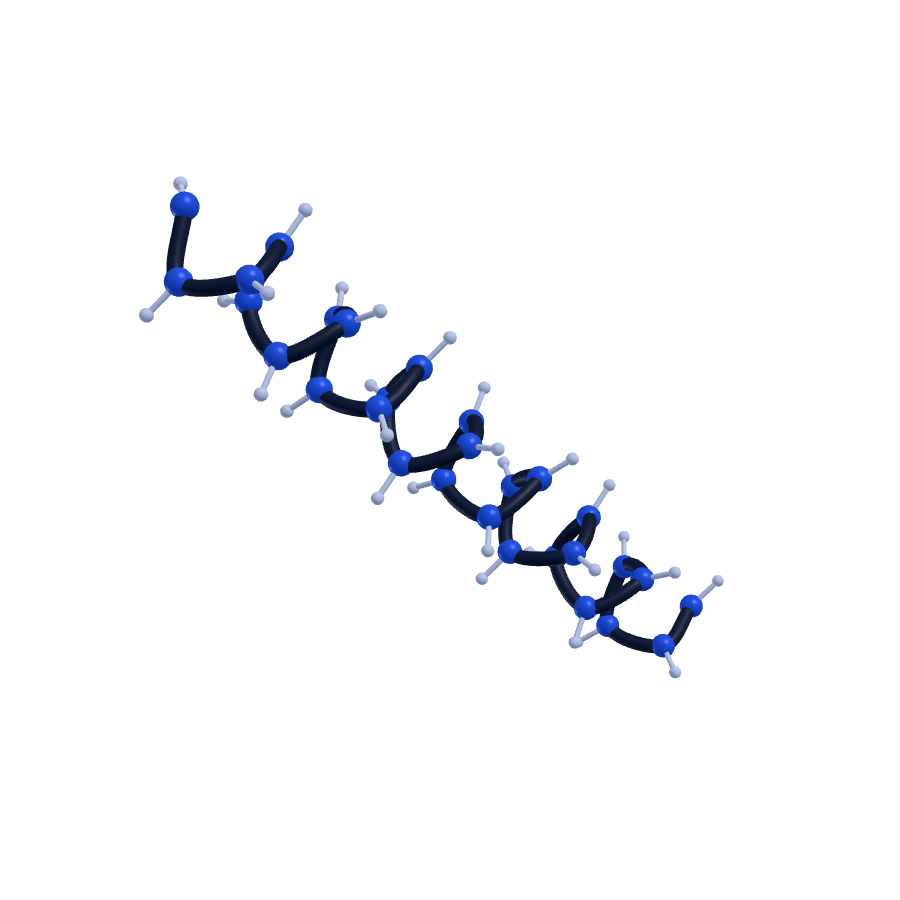
Growth-hormone-releasing hormone is 44 amino acids long, and its first 29 carry essentially all the activity. Sermorelin is that fragment, made synthetically. Because it prompts the pituitary to release its own growth hormone, the resulting pattern is pulsatile — closer to physiology than injected growth hormone.
It was sold as Geref from 1990, first for diagnosing growth-hormone deficiency in children and later for paediatric short stature. Serono withdrew it in October 2008; the withdrawal was commercial, and the FDA record does not attribute it to safety or efficacy concerns. In the US it remains available through 503A compounding pharmacies, which is why it occupies a different regulatory position from BPC-157 or TB-500.
How it is thought to work
It binds GHRH receptors on the pituitary, producing a pulse of growth hormone and, downstream, IGF-1. Because it works through the pituitary rather than bypassing it, the body's own feedback loops still apply — the argument for why it is gentler than exogenous growth hormone.
What is still unknown
- Whether raising GH and IGF-1 in healthy adults changes body composition, sleep or anything else people take it for.
- Long-term consequences of sustained IGF-1 elevation.
- How much the compounded product resembles the original pharmaceutical.
The molecule and how long it lasts
- Formula
- C149H246N44O42S
- Molecular weight
- 3357.9 g/mol
- CAS number
- 86168-78-7
- PubChem
- CID 16132413
PubChem record, read 23 September 2026.
- Route
- Subcutaneous (former Geref product); intravenous and intranasal in the PK study
- Half-life
- Rapidly eliminated after intravenous injection (minutes); the figure is not in the accessible abstract. Intranasal bioavailability 3–5%
From a published human pharmacokinetic study: Wilton P, et al. Pharmacokinetics of GHRH(1-29)-NH2 and stimulation of GH secretion in healthy subjects after intravenous or intranasal administration. Acta Paediatr Suppl 1993
Regulatory status
Historic Geref authorisations have lapsed; no product is authorised today. Supply for human use is an offence.
Geref was approved in 1997 and withdrawn from the market in 2008 for commercial reasons. Sermorelin acetate is not in Category 2 and is compounded by pharmacies on prescription; it remains unapproved as a product.
Not licensed by the MHRA. Selling or supplying it is an offence under the Human Medicines Regulations 2012; importing a small quantity purely for personal use is not itself an offence, but consignments are seized.
Prescription-only substance not on the ARTG. Possession without a prescription is an offence; imports without a prescription are seized.
No Drug Identification Number; selling it is illegal. Residents cannot import prescription drugs by mail.
GHRH analogue: S2.2.4.
Questions people actually ask
Is sermorelin FDA-approved?
Does sermorelin work for anti-ageing?
Sermorelin or CJC-1295?
One page per claimed effect
- ADoes Sermorelin help with growth hormone / IGF-1 elevation?Approval-grade paediatric data
- CDoes Sermorelin help with body composition in adults?Small studies, mostly open-label
- DDoes Sermorelin help with sleep quality?Anecdotal / small
- CHow common is safety in adults with Sermorelin?Compounding-era use
References
- 1Sermorelin evidence review: Geref approval history, withdrawal, and adult off-label data.Evidence review, 2026Secondary source used for approval and withdrawal history; adult RCT data described as limited.
Change log
- 2026-09-02Initial publication. Hormone-elevation outcome graded A on approval-grade data; adult body-composition claims graded C.